
RADON TESTING SERVICE
COMMERCIAL & RESIDENTIAL IN LAKE COUNTRY, KELOWNA, VERNON, PENTICTON & KAMLOOPS
Assure Property Solutions Inc. provides professional radon testing, measurement and reporting across the Okanagan and Interior BC.
The 2024 Cross-Canada Survey of Radon found that approximately 1 in 5 Canadian homes have radon levels at or above the Canadian guideline of 200 becquerels per cubic metre (Bq/m³).
Radon is invisible, odourless and tasteless. Testing is the only way to know the level in your building.
What is Radon Gas?
Radon is a naturally occurring radioactive gas produced by the breakdown of uranium in soil and rock. It has no colour, no smell and no taste, so it cannot be detected without a test. Radon moves through soil and enters buildings through cracks, gaps around pipes, floor drains, sump pits and other openings in the foundation, where it can accumulate to levels well above outdoor concentrations. Because it is invisible to the senses, measurement is the only way to know whether a building has a radon problem.
Is Radon Gas Harmful to Humans?
Yes. Radon is a radioactive gas that, when inhaled, damages lung tissue and increases the risk of lung cancer. It is the leading cause of lung cancer after smoking in Canada, and the leading cause among people who have never smoked. The risk is long-term and cumulative — it depends on how much radon is present, how long you are exposed, and whether you smoke. Smokers exposed to elevated radon face a substantially higher risk than non-smokers at the same level. Research on radon’s effects in pets is limited, so we don’t make claims about it.
Do We Have Radon Gas in Our Home or Building?
The only way to find out is to test. Assure Property Solutions Inc. provides professional radon testing, measurement and reporting for homes and buildings across the Okanagan and Interior BC. We place the radon monitors or long-term test kits, follow current testing procedures, and give you a clear written report showing your measured radon level and what it means against the Canadian guideline of 200 Bq/m³.
Why is Radon Testing Necessary in BC, Canada?
Radon can enter any building from the ground. Because it is invisible, odourless and tasteless, the only way to know the radon concentration in a specific home or building is to test. Long-term testing provides the most representative estimate of annual exposure and helps determine whether corrective action should be considered under Health Canada’s guideline of 200 Bq/m³.
Residential Radon Testing
Radon Analysis for Homes
Commercial Radon Testing
What Radon Level Requires Corrective Action?
The Government of Canada’s radon guideline is 200 becquerels per cubic metre (Bq/m³). For homes, Health Canada recommends corrective action when the average annual radon level exceeds 200 Bq/m³. If a home tests above 200 Bq/m³, corrective action should be taken within one year, and sooner as the radon level increases. For workplaces and other public buildings, Health Canada recommends remedial action within two years when long-term results are between 200 and 600 Bq/m³, and within one year when results are greater than 600 Bq/m³.
There is no level of radon considered risk free — the risk is cumulative and builds over years of exposure — which is why a long-term test is the only way to know where your building actually sits. If your long-term result is above the Canadian guideline of 200 Bq/m³, the next step is to consult a C-NRPP certified radon mitigation professional.
Some Canadians are living and working in homes and buildings with radon levels
above the Canadian guideline of 200 becquerels per cubic metre (Bq/m³)
Did You Know?
Radon is the leading cause of lung cancer after smoking, and the leading cause among people who have never smoked. It accounts for an estimated 16% of lung cancer deaths in Canada.
Do You Know the Radon Level in Your Home or Building?
Every home contains some level of radon. Testing is the only reliable way to find out what yours is.
Many British Columbians—and Canadians—haven’t thought about testing radon levels in their homes.
It’s Easy to Start a Test Today
Some Facts About Radon and Testing
Indoor radon levels vary from hour to hour, day to day and season to season. Levels are generally higher in winter and at night, when windows and doors stay closed. For that reason Health Canada defines a long-term radon measurement as one lasting at least 91 days, with a minimum of 91 days of the test falling during the heating season. Long-term measurements run 3 to 12 months and give the most reliable estimate of the annual average — the number the Canadian guideline of 200 Bq/m³ is written against. (A becquerel, or Bq, is a standard measure of radioactivity, named after French physicist Henri Becquerel.) This is why Assure’s radon testing season runs October 1 to April 30: your 91 days has to fit inside the heating season.
The only known health risk associated with exposure to high levels of radon in indoor air is an increased lifetime risk of developing lung cancer. The risk from radon exposure is long term and depends on the level of radon, how long a person is exposed and their smoking habits. If you are a smoker and are exposed to elevated levels of radon your risk of developing lung cancer increases significantly.

Radon Gas Levels in British Columbia
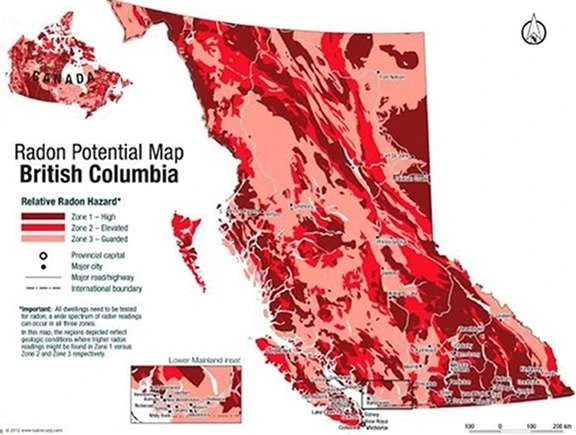
In Canada, the guideline for radon in indoor air is 200 Bq/m³. Health Canada recommends taking corrective action if the average annual radon level exceeds 200 Bq/m³, with action taken sooner as radon levels increase. While the health risk below 200 Bq/m³ is considered small, no level of radon exposure is considered completely risk-free.
What Happens When You Call
1. We confirm the property, the reason for testing and whether your 91 days fits inside the current season. If it doesn’t, we tell you that rather than take a booking that can’t produce a valid result.
2. We place the radon monitor or long-term test kit in the correct location and follow current Health Canada measurement procedures. The test runs at least 91 days during the heating season.
3. You receive a written report showing your measured radon level, what it means against the Canadian guideline of 200 Bq/m³, and what your options are if the result is elevated. We test and report. We do not sell mitigation.
Radon Testing FAQ
When can you test?
Our radon testing season runs October 1 to April 30. A valid long-term test needs at least 91 days inside the heating season, so we book tests that can finish within that window.
How long does the test take?
At least 91 days. Health Canada recommends a minimum of 91 days of the test occur during the heating season. Three to twelve months gives the strongest estimate of your annual average.
What does the result mean?
Your report shows your measured radon level against the Canadian guideline of 200 Bq/m³. Health Canada recommends taking corrective action within one year if your annual average is above 200 Bq/m³, and sooner the higher the level.
What happens if my result is above 200 Bq/m³?
Your report says so plainly and explains your options. You take it directly to a radon mitigation professional of your choosing.
Do you install radon mitigation systems?
No. Assure tests and reports only. We have nothing to sell you on the other side of the result, so the number you get from us is the number.
Do you test commercial buildings?
Yes. We test both residential and commercial properties across Lake Country, Kelowna, Vernon, Penticton and Kamloops.
What Clients Say About Our Radon Testing
★★★★★
“The services we had done included water quality testing, radon testing (long term), and air quality testing. Each time we were given thorough lab reports of the results with clear instructions on how to interpret findings. Clint is great and we highly recommend working with him.”
— Celine Cluff, Google Review